Quick search
CTRL+K
Quick search
CTRL+K


DVAThe healthcare sector is experiencing a major shift thanks to artificial intelligence (AI). This technology is changing how doctors diagnose illnesses, create treatment plans, and manage patient care. With the ability to analyze vast amounts of data quickly and accurately, AI is becoming an essential tool in medicine. From improving diagnostic accuracy to personalizing treatments, AI in healthcare is paving the way for a more efficient and effective system. In this article, we’ll look at the key innovations that are transforming the industry.
AI is making big changes in how we find and understand illnesses. It’s not just about faster results; it’s about seeing things we couldn’t before. Think of it as a super-powered magnifying glass for doctors, helping them spot problems earlier and with more accuracy. This shift is leading to quicker treatments and better outcomes for patients.
AI algorithms are now really good at looking at medical images like X-rays and MRIs. They can pick out tiny details that a human eye might miss. This is especially helpful in finding things like small tumors or subtle fractures. It’s like having a second, super-attentive pair of eyes on every scan. For example, AI can help doctors better understand how aggressive cancers are, sometimes even replacing the need for a biopsy with a “virtual biopsy”.
Pathology, which involves examining tissues and fluids, is also getting an AI upgrade. AI can analyze slides faster and more accurately than ever before. This means quicker diagnoses and more personalized treatment plans. Imagine getting your results back in hours instead of days, thanks to AI doing the initial heavy lifting. One study showed that AI was better at detecting early breast cancer (91%) than radiologists (74%).
AI can process huge amounts of patient data in real-time, looking for patterns and predicting potential problems. This is a game-changer for things like preventing sepsis or spotting heart issues early. It’s like having a constant health monitor that never sleeps, alerting doctors to potential problems before they become serious. For instance, at the University of Pennsylvania, doctors used a machine learning algorithm that can monitor hundreds of key variables in real time to anticipate sepsis or septic shock in patients 12 hours before onset.
AI’s ability to handle and analyze large datasets is one of its most remarkable attributes. AI can identify patterns in data that are not immediately apparent, providing doctors with tools to guide their decision-making. This can help clinicians to make faster and more accurate diagnoses, develop personalized treatment plans, and monitor disease progression more effectively, thereby improving patient outcomes.
Here’s a simple example of how AI might improve diagnostic accuracy:
Personalized medicine is getting a major boost from AI. It’s all about tailoring treatments to each person’s unique needs, and AI is making that way easier. Instead of a one-size-fits-all approach, doctors can use AI to analyze tons of data and figure out what works best for individual patients. It’s a game-changer.
AI can sift through mountains of patient data – like medical history, lifestyle, and even genetic info – to create treatment plans that are super specific. This means treatments are more likely to work and less likely to cause bad side effects. It’s like having a custom-made plan just for you. AI-driven models are transforming the management of chronic diseases like diabetes, hypertension, and heart disease. AI helps in continuous monitoring, offering patients personalized care through wearables and other smart devices. By analyzing real-time data, AI can alert both patients and providers about necessary interventions, preventing complications. Clinical decision support systems CDSSs can help assist healthcare professions to make better medical decisions by analyzing past, current, and new patient data.
Your genes play a big role in how you respond to medicine. AI can analyze your genomic data to predict how you’ll react to different treatments. This helps doctors choose the right drugs and dosages from the start. It’s like having a sneak peek into how your body will handle things. Technology may be able to determine new options for targeting therapies to an individual’s unique genetic makeup. Companies like BioXcel Therapeutics are working to develop new therapies using AI tools and machine learning.
AI isn’t just about looking at the past; it can also predict the future. By analyzing patient data, AI can predict how a patient is likely to respond to treatment and what their long-term outcomes might be. This helps doctors make better decisions and intervene early if needed. It’s like having a crystal ball for healthcare. The potential applications of AI in assisting clinicians with treatment decisions, particularly in predicting therapy response, have gained recognition. A study conducted by Huang et al. where authors utilized patients’ gene expression data for training a support ML, successfully predicted the response to chemotherapy.
In this study, the authors included 175 cancer patients incorporating their gene-expression profiles to predict the patients’ responses to various standard-of-care chemotherapies. Notably, the research showed encouraging outcomes, achieving a prediction accuracy of over 80% across multiple drugs. These findings demonstrate the promising role of AI in treatment response prediction. In another study performed by Sheu et al., the authors aimed to predict the response to different classes of antidepressants using electronic health records (EHR) of 17,556
AI in personalized medicine is not just about technology; it’s about improving patient care and outcomes. By using AI to tailor treatments, we can make healthcare more effective, efficient, and safe for everyone.
The traditional methods of discovering and developing drugs are often slow and costly. AI is changing that by speeding up various stages of the process. It’s not just about making things faster; it’s about making them smarter, too. AI algorithms can analyze huge amounts of data to find patterns and insights that humans might miss. This can lead to the identification of new drug candidates and the repurposing of existing drugs for new uses. The use of AI in drug discovery is becoming more and more common.
AI is really good at sifting through mountains of data quickly. This is a game-changer in drug research, where scientists often have to analyze countless chemical compounds and biological pathways. AI algorithms can predict how different compounds will interact with the body, helping researchers narrow down their focus and prioritize the most promising candidates. This not only saves time but also reduces the resources needed for early-stage research.
One of the biggest challenges in drug discovery is finding the right molecules that can effectively target a disease. AI can help with this by analyzing data from various sources, including genomic data, clinical trials, and scientific literature. This allows researchers to identify potential drug candidates with a higher degree of accuracy.
Getting a new drug to market can take years, even decades, and cost billions of dollars. AI has the potential to significantly reduce this timeline by streamlining the entire process, from initial discovery to clinical trials. By accelerating research, identifying promising candidates, and predicting potential problems, AI can help pharmaceutical companies bring new treatments to patients faster. This is especially important for diseases where there is an urgent need for new therapies.
AI is not going to replace human researchers, but it will augment their abilities. By automating many of the tedious and time-consuming tasks involved in drug discovery, AI frees up scientists to focus on the more creative and strategic aspects of their work. This collaboration between humans and machines has the potential to revolutionize the way drugs are developed and brought to market.
Healthcare is swamped. There’s paperwork, regulations, and just a ton of data to manage. AI is stepping in to help, and honestly, it’s about time. It’s not just about cutting costs; it’s about making things run smoother so doctors and nurses can focus on what they do best: taking care of people. AI can automate tasks, predict patient flow, and even optimize staffing schedules. It’s like giving the whole system a much-needed upgrade.
Think about how hospitals manage beds, equipment, and staff. It’s often a guessing game, leading to shortages in some areas and surpluses in others. AI can analyze data to predict demand, ensuring resources are where they need to be, when they need to be. This means fewer delays, better patient care, and less stress for everyone involved. For example, AI algorithms can assist with triaging patients based on urgency.
Nobody likes waiting in a hospital. AI can help reduce wait times by optimizing patient flow. It can analyze data to identify bottlenecks, predict patient arrival patterns, and even automate appointment scheduling. This not only improves the patient experience but also frees up staff to focus on more critical tasks. It’s about making the whole process more efficient and less frustrating.
Administrative tasks eat up a huge chunk of time in healthcare. From billing to managing patient records, there’s a lot of paperwork involved. AI can automate many of these tasks, freeing up staff to focus on patient care. This means fewer errors, faster processing times, and a more efficient operation overall. Administrative workflow automation is a game changer.
AI in healthcare isn’t just about fancy technology; it’s about making the system work better for everyone. By automating tasks, optimizing resources, and improving patient flow, AI can help healthcare providers deliver better care, more efficiently, and with less stress.
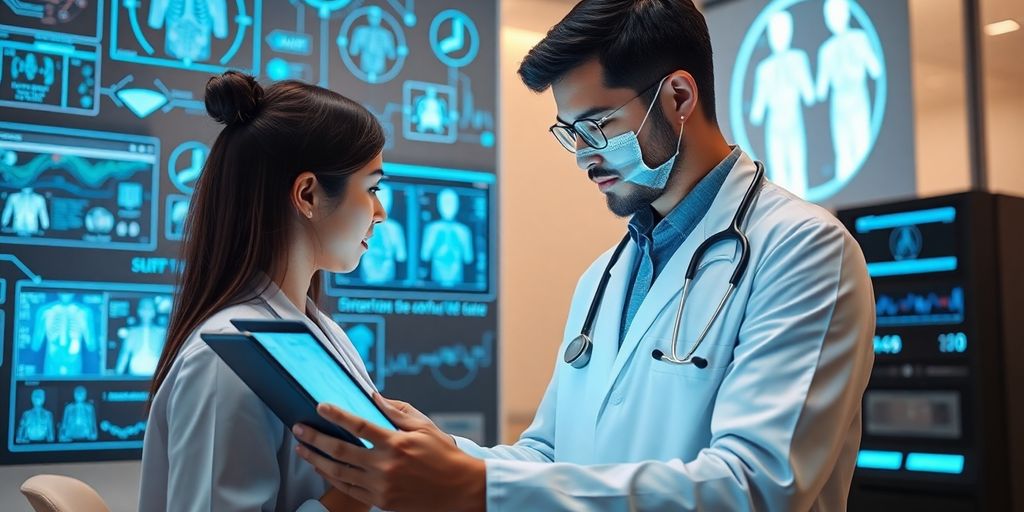
Virtual health solutions are changing how people access healthcare. It’s not just about video calls with your doctor anymore; AI is bringing a whole new level of sophistication to the field. Think about it: personalized health advice, remote monitoring, and even mental health support, all powered by AI. It’s pretty wild.
Telemedicine has been around for a while, but AI is making it way better. AI algorithms can analyze patient data during virtual consultations, helping doctors make more accurate diagnoses. This means faster, more effective treatment, even when you can’t physically be in the same room. Plus, AI can automate tasks like scheduling appointments and sending reminders, freeing up doctors to focus on patient care. It’s a win-win.
AI is also making a big impact on mental health support. Chatbots powered by AI can provide therapy and support to people who might not otherwise have access to it. These chatbots can offer a safe, non-judgmental space for people to talk about their feelings and learn coping mechanisms. It’s not a replacement for traditional therapy, but it can be a valuable tool for people who are struggling. The adoption of health care augmented intelligence is growing rapidly.
Remote patient monitoring is another area where AI is shining. Wearable devices and sensors can collect data on patients’ vital signs, activity levels, and sleep patterns. AI algorithms can then analyze this data to identify potential health problems early on. This allows doctors to intervene before the problem becomes serious, potentially preventing hospitalizations and improving patient outcomes. It’s like having a personal health monitor that’s always watching out for you.
AI-powered virtual health solutions have the potential to transform healthcare by making it more accessible, affordable, and personalized. However, it’s important to address the ethical considerations surrounding AI in healthcare, such as data privacy and security, to ensure that these technologies are used responsibly.
Here’s a quick look at the benefits of AI-powered remote patient monitoring:
AI’s making waves in healthcare, but it’s not all smooth sailing. We need to think about the ethical side of things to make sure we’re using this tech responsibly. It’s not just about cool algorithms; it’s about people’s lives and well-being. Let’s be real, messing this up could have serious consequences.
Okay, so imagine all your health info floating around in some AI system. Kinda scary, right? We’re talking about super sensitive stuff, and we need to make sure it’s locked down tight. Data breaches could be a total nightmare, exposing personal details and messing with people’s trust in the whole system. Think about cybersecurity strategies and how important they are. It’s not just about following the rules; it’s about doing what’s right for patients.
AI learns from data, and if that data is biased, the AI will be too. This means some patients might not get the best care simply because of their race, gender, or background. It’s like the AI is seeing the world through a skewed lens. We need to actively work to remove these biases from the data and the algorithms themselves. Otherwise, we’re just reinforcing existing inequalities in healthcare.
So, who’s in charge of making sure all this AI stuff is safe and fair? That’s where regulations come in. But the thing is, AI is moving so fast that the rules are struggling to keep up. We need clear guidelines about how AI can be used in healthcare, who’s responsible when things go wrong, and how to protect patient rights. It’s a tricky balance between encouraging innovation and preventing harm. It’s important to have ethical implications in mind when creating these regulations.
Figuring out the right regulations is tough. We don’t want to stifle innovation, but we also can’t let companies run wild with AI without any oversight. It’s a constant balancing act, and we need to involve everyone – doctors, patients, tech experts, and lawmakers – to get it right.

It’s wild to think about where AI in medicine is headed. We’re already seeing some amazing stuff, but the future? It’s like something out of a sci-fi movie. The amount of medical info out there is growing so fast that doctors can’t keep up. AI is going to be key in helping them sort through it all and make better decisions.
Imagine your smartwatch not just tracking your steps, but also constantly monitoring your vital signs and alerting you (and your doctor) to potential problems before they become serious. That’s the direction we’re heading. Wearable tech is getting more sophisticated, and AI is getting better at analyzing the data they collect. It’s a powerful combination for preventive care.
Robots in surgery are already a thing, but they’re going to become even more precise and versatile. Think about robots that can perform complex procedures with minimal invasiveness, leading to faster recovery times and better outcomes for patients. Robotics will also play a bigger role in assisting elderly or disabled individuals, providing them with greater independence and quality of life.
AI isn’t just about treating illnesses; it’s also about preventing them. Advanced algorithms can analyze your lifestyle, genetics, and medical history to identify your risk factors for various diseases and recommend personalized strategies to reduce those risks. It’s like having a personal health coach that’s available 24/7.
AI’s role in preventive healthcare is set to explode. We’re talking about personalized diet plans, exercise recommendations, and even early detection of diseases like cancer through AI-powered screening tools. The goal is to keep people healthy and out of the hospital in the first place.
Here’s a quick look at how AI could impact preventive care:
In the end, AI is changing healthcare in ways we never thought possible. It’s not just about fancy tech; it’s about real improvements in how we diagnose and treat patients. From spotting diseases earlier to making treatments more personalized, AI is making a difference. Sure, there are still some bumps in the road, like privacy concerns and the need for human oversight, but the potential is huge. As we keep moving forward, we can expect even more breakthroughs that will help patients and healthcare providers alike. So, it’s an exciting time to be in healthcare, and the future looks bright with AI on our side.
AI in healthcare refers to the use of technology that can perform tasks that usually require human intelligence. This includes analyzing data, making diagnoses, and suggesting treatments.
AI improves medical imaging by helping doctors identify problems in images like X-rays and MRIs more accurately and quickly. It can spot things that a human might miss.
Personalized medicine means tailoring medical treatments to individual patients based on their unique health data, like genetics, to get the best results.
AI speeds up drug development by analyzing data to find potential new drugs faster and making the research process more efficient.
Ethical concerns include issues like data privacy, making sure AI doesn’t have biases, and figuring out who is responsible if something goes wrong.
The future of AI in healthcare looks promising, with trends like wearable technology, advanced robotics, and better preventive care on the horizon.


